


USER PROFILE:
AN AMERICAN MANUFACTURER PUSHING THE ENVELOPE IN POWER SYSTEM PROTECTION
Schweitzer Engineering Laboratories, Inc. (SEL) invents, designs, and builds systems that protect power grids around the world. Since 2001, SEL has used the RTDS® Simulator to support their work at their headquarters in Pullman, Washington.
Today, after many upgrades and expansions, they operate state-of-the-art RTDS Simulators in several divisions of the company, spanning multiple locations in the United States, as well as two offices abroad. In their R&D division, real-time simulation and hardware-in-the-loop (HIL) testing are an important part of the validation process for protection, control, and automation products—particularly for those with novel elements. SEL have positioned themselves as an innovator in the power system automation space, and HIL testing provides confidence to the early adopters of their solutions: forward-thinking utilities and system operators worldwide.
Today, after many upgrades and expansions, they operate state-of-the-art RTDS Simulators in several divisions of the company, spanning multiple locations in the United States, as well as two offices abroad. In their R&D division, real-time simulation and hardware-in-the-loop (HIL) testing are an important part of the validation process for protection, control, and automation products—particularly for those with novel elements. SEL have positioned themselves as an innovator in the power system automation space, and HIL testing provides confidence to the early adopters of their solutions: forward-thinking utilities and system operators worldwide.
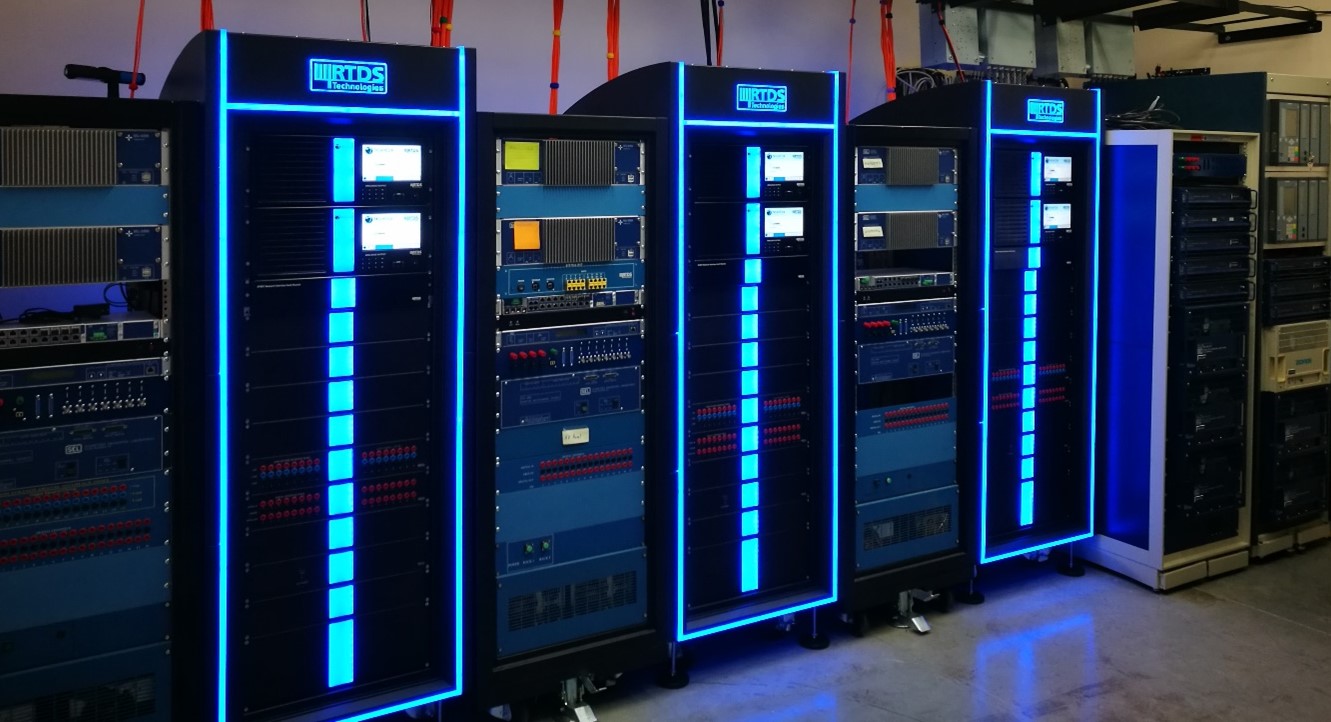 Racks of automation equipment alongside the RTDS Simulator at SEL's R&D lab Image courtesy of SEL
PROJECT FOCUS:
COMPREHENSIVELY VALIDATING RELAY PERFORMANCE PRIOR TO RELEASE
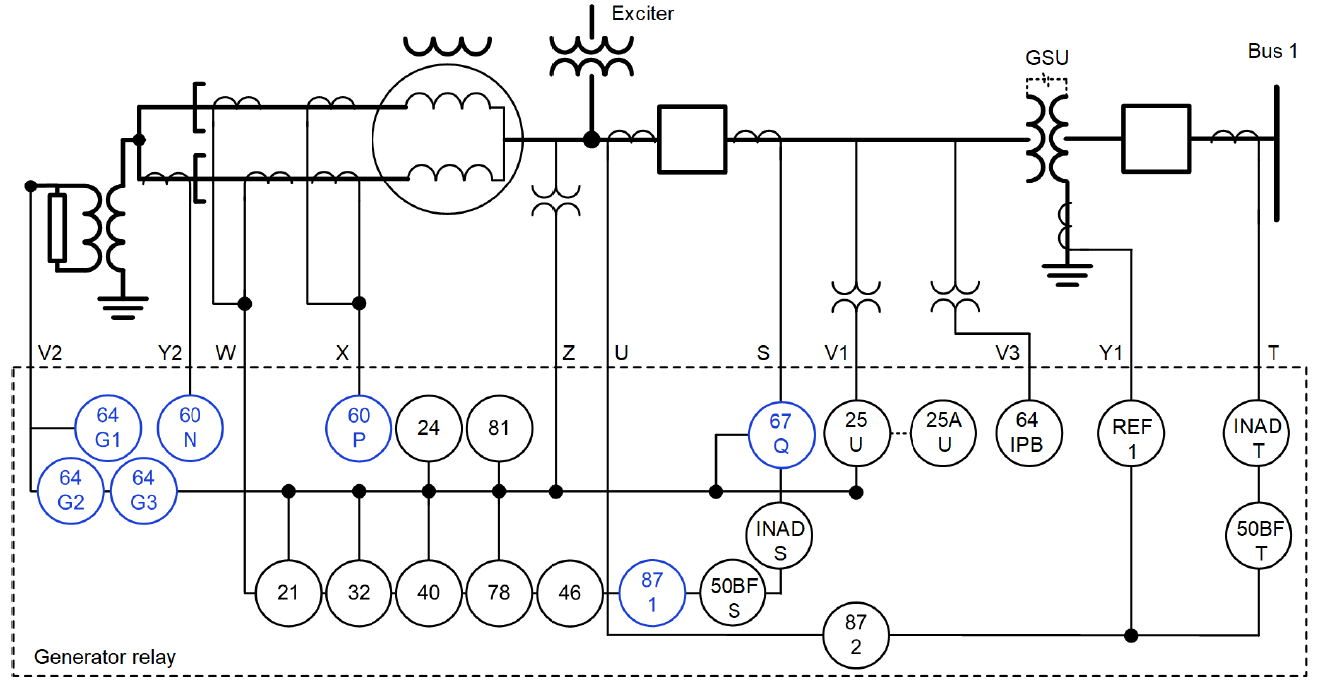 Interface points between the simulated generator and various protection elements of the relay* | Image courtesy of SEL
The SEL-400G Advanced Generator Protection System is a powerful multifunction relay with several novel protection elements. Thorough validation of the new relay’s performance for a wide variety of events was a critical part of the development process for SEL.
The SEL-400G relay was connected to the simulated network—including the generator, exciter, instrument transformers, generator step-up transformer, and breakers via analogue and digital outputs and inputs. The protection’s correct response to various simulated power system events could then be validated.
The following events were included in the HIL testing process:
- Internal faults, including phase, ground, turn, and series faults
- External faults
- Motoring
- Overexcitation
- Loss of excitation or underexcitation
- Inadvertent energization
- Stuck breaker
- Faults during static start
- Stressed power system, including power swings, generation or load rejection, and islanding
- Instrument transformer misbehaviour
MODEL HIGHLIGHT:
THE RTDS SIMULATOR’S ADVANCED FAULTED GENERATOR MODEL PUT TO WORK
RTDS Technologies developed an advanced real-time synchronous machine model which allowed SEL to test unprecedented aspects of generator protection. The model is based on an embedded phase-domain approach, which provides superior numerical stability and flexibility while allowing for simulation of a wide range of internal faults.
In the faulted PDSM model, each stator winding has two parallel branches which are divided into two subwindings each for a total of 12 subwindings. All 24 internal nodes are accessible to the user as independent nodes in the circuit—they can be connected to fault branches or other power system components. The field winding is treated similarly.
The model provides state-of-the-art flexibility in testing generator protection, allowing for turn-to-turn faults, faults between phases, faults between different parallel branches of the same phase, and series faults. It supports asymmetry between stator parallel branches for the testing of the split-phase protection.
 The RTDS Simulator’s advanced faulted PDSM model.
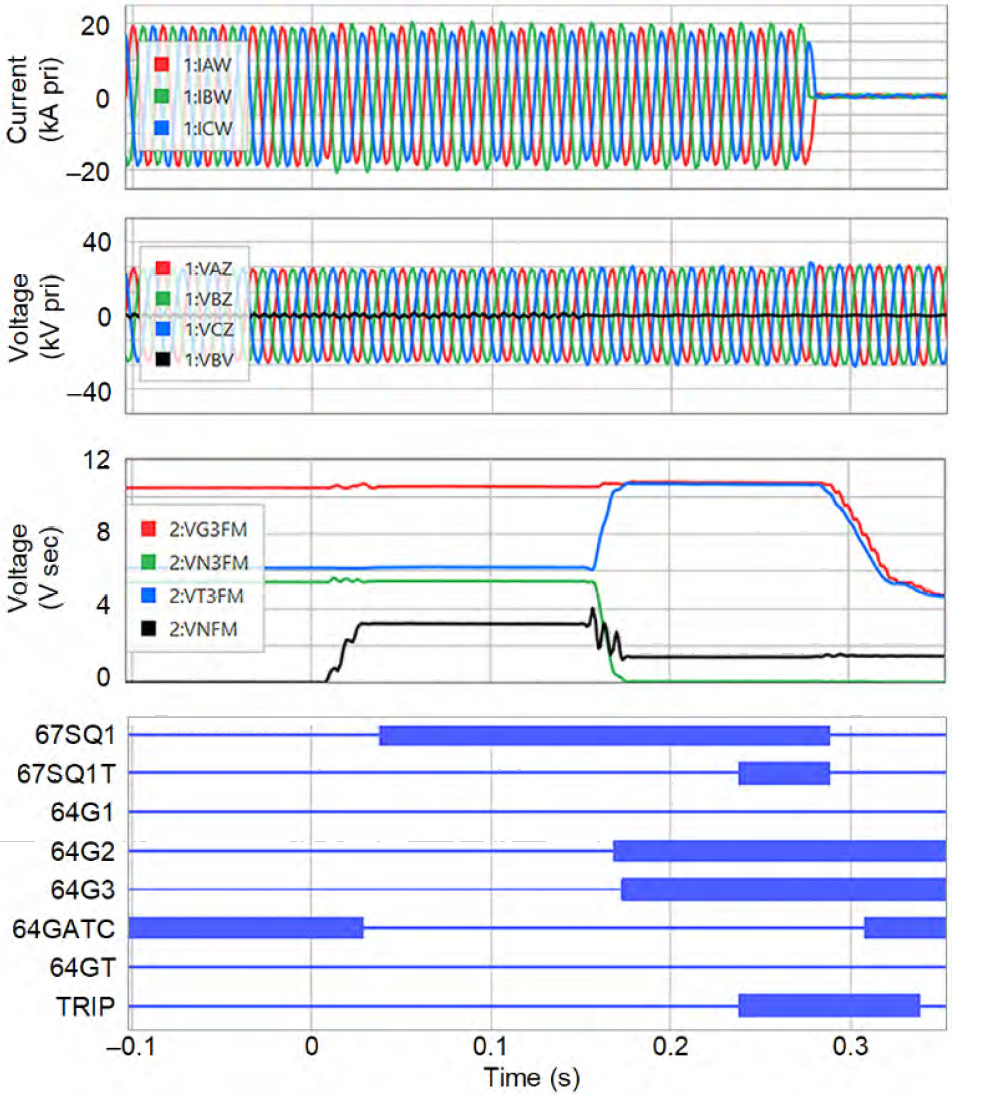 Relay and model response to a neutral-sides series fault evolving to ground.
OUTCOMES:
COMPREHENSIVELY VALIDATING RELAY PERFORMANCE PRIOR TO RELEASE
Validation testing with the RTDS Simulator confirmed the SEL-400G’s ability to detect most internal faults and provided application guidance that would otherwise be difficult to identify.
- The stator ground fault protection elements (neutral overvoltage and third harmonic) were verified to operate quickly for intermittent faults near the generator terminal and neutral.
- The general differential element was verified as sensitive for all phase faults within the stator winding, including challenging faults near the neutral.
- Turn faults were applied from 2% to 98% (extrapolated to 100%) of various branches. The sensitivities of split-phase and negative sequence directional elements were compared.
- The negative-sequence directional element (67Q) was verified to detect series faults on one phase given sufficient imbalance. Ground fault protection detected these faults once they evolved to ground. Coordination of 67Q, which is not typically applied for generator protection today, and the ground fault acceleration scheme is required to ensure reliable tripping for these potentially damaging conditions.
Hardware-in-the-loop validation testing with the RTDS Simulator allowed SEL to connect the 400G relay to a simulated network and subject it to a wide variety of power system events in the safety of the laboratory environment, providing more insight and application guidance than is evident in the traditional commissioning.
LEARN MORE ABOUT HIL TESTING FOR DISTRIBUTION AUTOMATION SYSTEMS AT RTDS.COM/APPLICATIONS