


Exchange data in real time
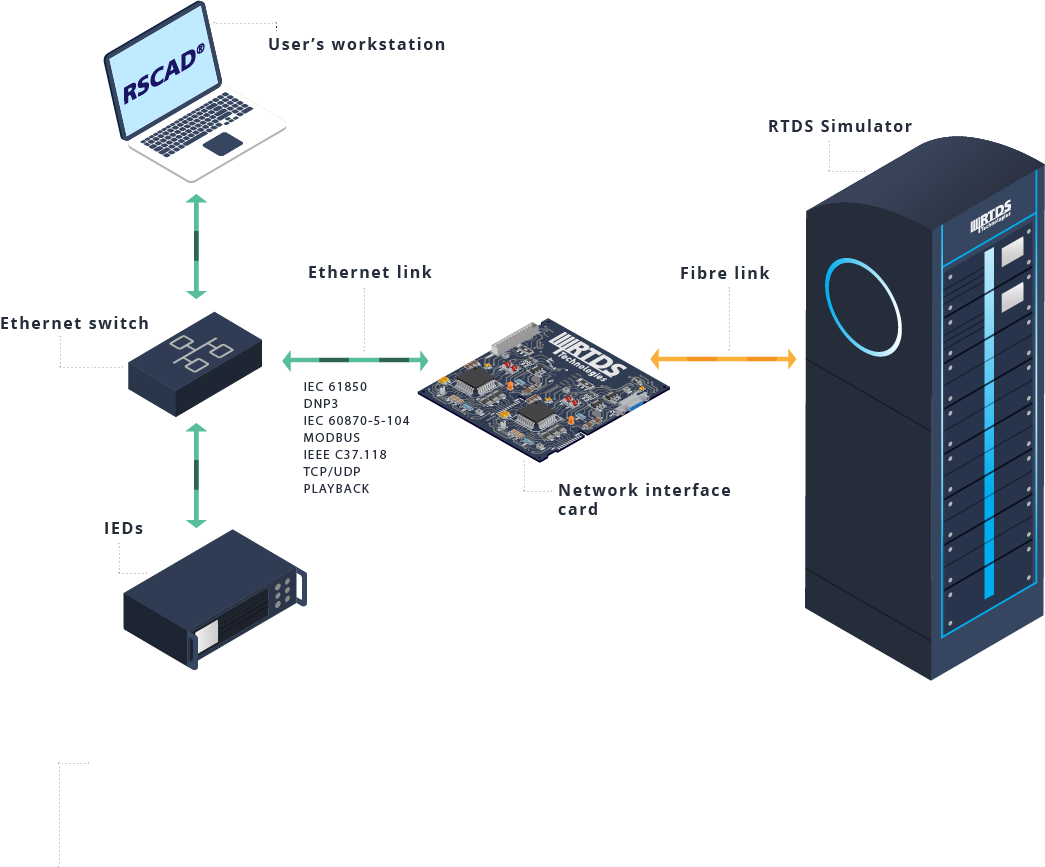
The RTDS Simulator can exchange data with external hardware or software devices in real time through many different communication protocols. Input and output via Ethernet (though standard-compliant data packets) allows the closed-loop testing of digital substations and other non-wires alternatives.
The hardware that gets it done: Network Interface Card
The RTDS Simulator’s GTNETv3 Network Interface Card provides a real-time communication link to and from the simulated network via different Ethernet-based protocols.
PRP Support
The GTNETv3 natively supports communication redundancy with Parallel Redundancy Protocol (PRP) for all below network protocols.
In PRP mode, each GTNET module accesses two Ethernet ports for fully redundant communication, so all four Ethernet ports on the card are utilized.
Normally, when PRP is not active, each module accesses only one Ethernet port.
Supported Communication Protocols
-
The SV firmware option provides IEC 61850-9-2 / IEC 61869-9 Sampled Value messaging for power system voltages and currents. In order to timestamp the sampled values, the simulation must be synchronized to an external time reference (1PPS, IRIG-B, or IEEE 1588) using the GTSYNC card. In output mode, GTNET-SV can publish up to 2 independent SV streams simultaneously. Each IEC 61869-9 stream can have up to 24 channels at sampling rates of 80 and 96 samples/ cycle and 4800 Hz. Each stream can have up to 9 channels at sampling rates of 256 samples/cycle and 14,400 Hz. In input mode, GTNET-SV can subscribe to one SV stream (with the same sampling rate and channel limits as written above). GTNET-SV can be configured to publish/subscribe regular SV or routable SV (R-SV). If you’re interested in higher SV sampling rates or large quantities of SV streams simultaneously, we recommend GTSOC-SV (see information on the GTSOC V2).
-
- The GTNET-GSE firmware provides IEC 61850 Ed 2.0 and 2.1 GOOSE communication and MMS server services. GTNET- GSE can simulate 1-4 IEDs, which can be configured to publish/subscribe regular or routable GOOSE.
- Each GTNET-GSE firmware can publish up to 16 GOOSE message streams and receive GOOSE messages from up to 32 unique external IEDs. Each firmware can publish up to 512 data items (of types integer, Boolean, double position, float or quality) and can receive up to 512 data items.
- The GTNET GOOSE configuration is done via a companion software tool within RSCAD called the IED Configuration Tool.
- IEDs simulated by GTNET-GSE component can include standard IEC 61850 data models obtained from the ICTs’ Logical Node (LN) database. In addition, the GTNET-GSE supports simulated switch-objects to represent and test switchgear operations, test (simulated) GOOSE messages, and GOOSE subscription monitoring.
-
- The GTNET-MU firmware provides combined IEC 61850-9-2 / IEC 61869-9 SV (Sampled Values), IEC 61850-8-1 GOOSE, and MMS server services. It combines a selected set of GTNET-GOOSE and GTNET-SV capabilities in the simulation of a single IED. It can publish up to 8 GOOSE message streams and 1 SV stream. It can subscribe to up to 8 unique GOOSE streams. GTNET-MU acts as an IEC 61850 MMS server device.
-
The PMU firmware provides synchrophasor output data streams according to the IEC/IEEE 60255-118-1 standard. Two PMU streaming options are available for GTNET-PMU.
Using the first option, a single GTNET-PMU firmware can represent and provide output for up to eight (8) PMUs with symmetrical component information related to 3-phase sets of voltage and current using UDP or TCP connections. The reporting rate of each PMU can be set individually between 1 and 60 frames per second. Using this option, reporting rates as high as 240 frames per second are supported. Frame rates as high as 240 frames per second are supported, but require the maximum number of PMUs represented by one GTNETv3 to be reduced from eight. Using the second option, a single GTNET-PMU firmware can represent and provide output for up to twenty four (24) PMUs containing only positive sequence data. Frame rates up to the system frequency (50/60 Hz) are supported.
-
- The MODBUS firmware provides Modbus communication over TCP/IP networks using the GTNETv3 hardware. The component supports Modbus TCP, Modbus UDP, Modbus RTU over TCP, and Modbus ASCII over TCP. GTNET-MODBUS can operate either as a Modbus server/outstation or a Modbus client/master, communicating with an external server or client through the GTNETv3 module’s Ethernet port. Each instance of the MODBUS firmware can simulate up to 10 outstations simultaneously, each with independent data mapping. Each outstation can maintain two concurrent communication channels for 20 connections in total. Or, each MODBUS instance can simulate up to 2 clients simultaneously, each with independent data mapping, and supporting up to 20 devices connections in total between the clients.
-
- The GTNET-DNP and GTNET-104 firmwares allow the GTNETv3 module to act as a DNP3 or IEC 60870-5-104 slave. Each instance of the DNP or 104 firmware supports simulation of up to 10 outstations, with a maximum of 2 masters connected per outstation (20 connections total). The maximum polling rate is 5 Hz.
-
The Playback firmware option is used to read large data files stored on a PC hard drive and allow them to be played back in an RTDS simulation. Sampling frequencies as high as 20 kHz can be maintained in a true real time simulation. Up to 48 channels of floating point data can be imported from an external data file (COMTRADE or ASCII).
The GTNET card brings in the data using TCP/IP Ethernet communication. Because the data file is stored remotely on a PC, file sizes of several GB can be handled easily. The component also allows for independent pre and post fault looping.
-
- Using the Socket (SKT) protocol, the GTNETv3 module communicates with external software and physical equipment over a Local or Wide Area Network connection using TCP or UDP sockets. When communicating with a single external device, GTNET-SKT is capable of sending up to 300 input and output data points per packet. When communicating with multiple external devices (to a maximum of 10), GTNET-SKT is capable of managing up to 30 input and 30 output data points for each channel.