


The RTDS Simulator allowed utilities, manufacturers, and research and educational institutions to test multiple devices in a closed loop with the simulated network while easily adjusting network parameters, contingency scenarios, and device settings for the first time.
Real-time digital simulation with the RTDS Simulator rose from emerging technology to industry standard for comprehensively de-risking the integration of control and protection systems and power equipment.
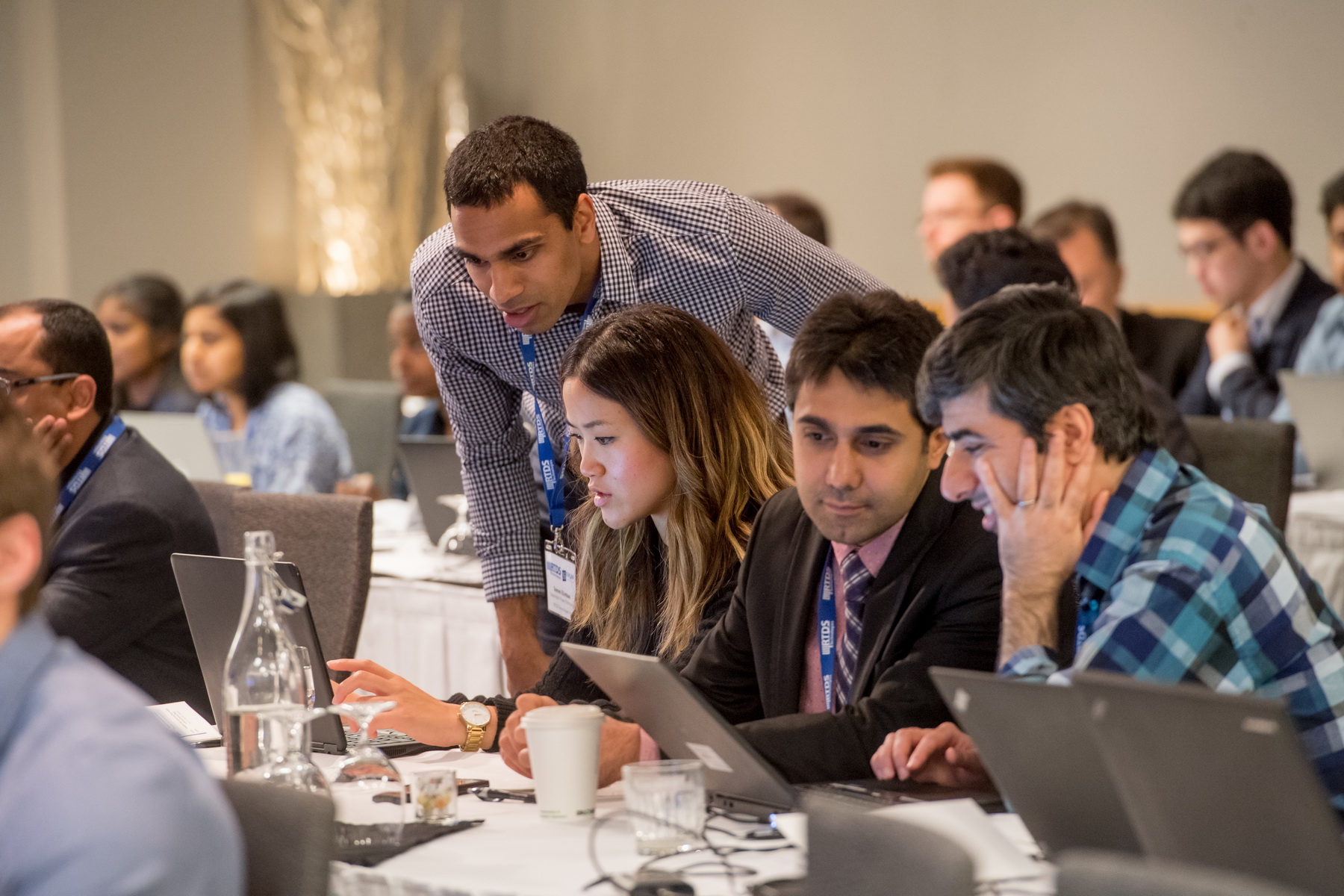
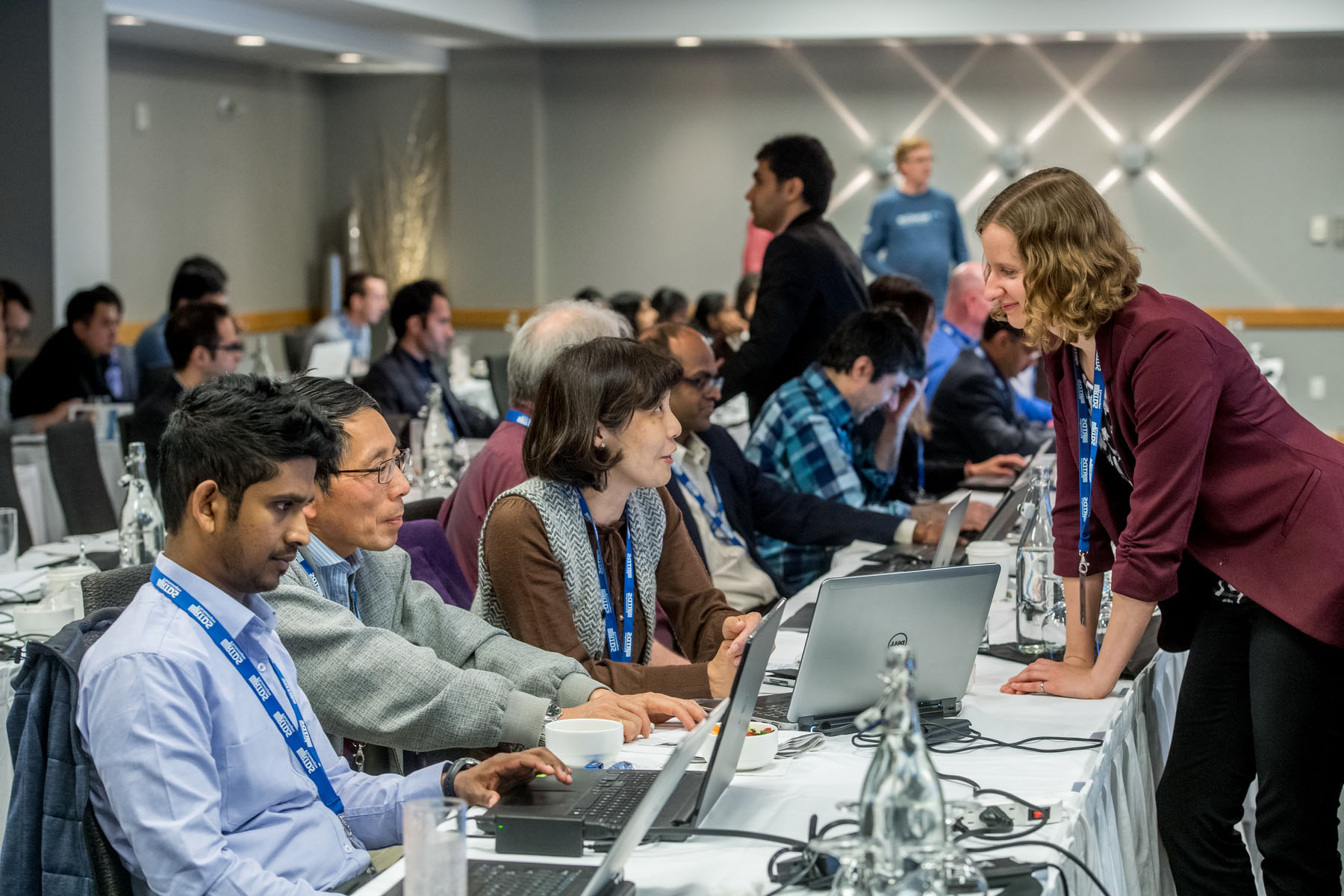
Why do we continue to be the tool of choice for industry leaders today? Our commitment to user support.
The RTDS Simulator uses highly customized proprietary hardware and software, developed specifically for real-time power system simulation by RTDS Technologies. This deep product knowledge allows us to achieve unparalleled efficiency and stability for our simulations and support our users in ways that other simulator providers can’t.
- World-class dedicated simulation support team to help users achieve the most meaningful and successful possible projects
- Comprehensive technical support for even the most uncommon and complex software or hardware issues
- Simulations running bare-metal and with cache-only memory on IBM’s POWER8™ processor for ultimate efficiency
- Highly robust and proven power system and power electronics modelling library through thirty years of experience
Made in Canada, used worldwide
The entire RTDS Technologies team works out of our state-of-the-art facility in Winnipeg, Manitoba, Canada – a global hub for power systems research. Here, some of the greatest minds in our industry develop our software and hardware, provide technical support to our users, and run all the needed behind-the-scenes tasks to support the worldwide reach of the RTDS Simulator, currently used in over 50 countries.

We work with exclusive representatives around the world to help provide local sales and technical support in a large number of countries and territories.
Contact US
-
RTDS Technologies Inc. is the exclusive supplier of the RTDS® Simulator – the world standard for real-time digital power system and power electronics simulation. The company provides real-time simulation hardware, the RSCAD FX simulation software, and simulation support to utilities, TSOs and DSOs, control and protection equipment vendors (OEMs), research institutes, universities, consultants, and EPCs in over 60 countries.
The RTDS Simulator and RSCAD FX are the leading real-time simulation tool for power systems applications in the world.
The RTDS Simulator originated from a research project at the Manitoba HVDC Research Centre, which produced the world's first real-time digital HVDC simulation in 1989. RTDS Technologies is headquartered in Winnipeg, Manitoba, Canada, and is now part of AMETEK.
-
The RTDS Simulator is a real-time digital power system simulator. It consists of dedicated hardware (NovaCor 2.0 and NovaCor Light) and software (RSCAD® FX), and performs electromagnetic transient (EMT) simulation of power systems in real time. Real-time operation enables hardware-in-the-loop (HIL) testing, in which external equipment – protection relays, controllers, inverters, and other real power system devices – can be connected directly to the simulated network in a closed loop. HIL testing with the RTDS Simulator allows equipment to be stress-tested in realistic power system conditions before it is deployed in the field.
-
RTDS Technologies pioneered this technology for the power industry, and it was first adopted by major OEMs for critical HVDC control system testing in the early 1990s. More than 30 years later, why does the RTDS Simulator and RSCAD FX hardware continue to be the de facto tool used by leaders in the power industry? There are many factors, and among them are our design philosophy, commitment to technical excellence, and commercial approach. Here are some examples:
- Custom-integrated hardware instead of adapted general-purpose computing: NovaCor is designed and built specifically for real-time power system simulation, rather than repurposing off-the-shelf computing hardware. Full in-house control over the hardware is what lets RTDS Technologies guarantee hard real-time performance and provide leading hardware support to our users.
- A single, all-in-one, software environment: RSCAD FX is developed entirely in-house, meaning the modelling library, operator interface, scripting tools, and documentation are all developed in the same building that builds the hardware they run on. Again, this allows RTDS Technologies to react quickly and comprehensively to customer queries relating to the software and fix bugs.
- No third-party components in the critical path: Because RTDS Technologies owns the full product – processing hardware, I/O, and every software module – every component is validated together as a system, rather than assembled from third-party parts whose interactions and compatibility may vary and are difficult to control.
- Direct, in-house technical support: Simulation support for RTDS Simulator users comes from the same organization that designs and builds every component of the Simulator, including every model in our library. That means the people helping troubleshoot a project are working from the same institutional knowledge that built the product, with decades of applied power systems and power electronics expertise behind every answer. We’re proud to help the leaders in the power systems and power electronics spaces develop simulations and HIL tests efficiently and effectively.
- Straightforward, transparent pricing: The RTDS Simulator’s all-in-one software architecture and site license for RSCAD FX means that customers know what they’re getting, both at the outset of the project and for years to come – no additional fees for different modules and capabilities, per-seat fees, or usage-based charges. Permanent core licenses for the RTDS Simulator’s processing hardware make budgeting straightforward and means future teams won’t have to deal with scaled back capabilities. RTDS Simulator hardware is designed with inter-generational compatibility in mind, and upgrade paths make new-generation hardware accessible for customers.
-
HIL testing is the practice of connecting real physical equipment to a simulated power system in a closed loop. The device(s) under test are interfaced using inputs and output signals. I/O might be analogue signals, wet or dry digital signals, or Ethernet-based communication protocol streams. Because the equipment doesn’t know the difference between the simulation in the lab and the real world, it behaves exactly as it would on the actual grid. This allows engineers to de-risk and validate the dynamic behaviour a control, protection, or power device under realistic and repeatable conditions, including rare or high-consequence events that would be impractical or unsafe to reproduce on live equipment.
To conduct HIL testing, you need a real-time simulator which consists of dedicated processing hardware, PC-based software that allows the user to interact with the simulated environment, and I/O devices. Of course, you’ll also need your device under test, which could be an inverter controller, power plant controller, protective relay, HVDC & FACTS control cubicle, and much more.
-
Real-time simulation and HIL testing let engineers validate real equipment against realistic, repeatable grid conditions, safely and efficiently in the lab, before deployment on the real power system.
- De-risking control and protection schemes: HIL testing uniquely reveals potential control interactions, firmware bugs, timing/scheduling issues, and other interoperability factors that can cause misoperation and significantly impact the security and resilience of the power system
- Faster, more confident commissioning: issues found and resolved in the lab reduce the risk of surprises, delays, and downtime during actual field commissioning
- Validation of offline models for confidence in device behaviour: OEMs can verify their offline EMT device models against the real equipment in the lab to prove that their models accurately capture the dynamic behaviour of the device in a wide range of conditions
- Multi-vendor interoperability: equipment from different manufacturers can be connected to the same simulated network to validate that their protection, control, or communication schemes work correctly together
- Rare, extreme, or high-consequence events (major faults, cascading outages, cyberattacks) can be reproduced and studied without any risk to a live power system
- Hundreds of test scenarios can be automated via scripting, with results available immediately, dramatically reducing the hands-on time needed compared to other forms of simulation and testing
-
EMT simulation is a time-domain, instantaneous-value representation of the power system. EMT simulations typically run at microsecond-level timesteps, capturing fast transients, switching events, and high-frequency phenomena. In contrast, RMS (phasor-domain/transient stability) simulation typically provides a phasor output at fundamental frequency, running at much larger timesteps (milliseconds range). This means that EMT simulation can represent the fast-acting controls of inverter-based resources and the phenomena of concern they may produce in the power system, while phasor-domain simulation is blind to most of these issues. EMT simulation is a critical tool for the modern power system engineer.
-
The core difference is real-time operation. Offline EMT tools run simulations on a desktop PC, without the requirement that each timestep be solved within its real-world time duration. This means that offline EMT simulations can take a long time – minutes or even hours to generate a few seconds of power system data, especially for large and complex networks.
The RTDS Simulator uses dedicated, custom-integrated parallel processing hardware to guarantee real-time operation: all calculations for a given simulation timestep are completed in real-world time equal to or less than that timestep’s duration (typically 25-50 microseconds, but sometimes as low as 1-3 microseconds or even in the nanosecond range for power electronics). This means that 5 seconds of power system information takes 5 seconds to calculate, no matter how complex the model. Real-time operation enables interfacing to external equipment in a HIL testing environment – something that offline tools cannot do.
-
Controller hardware-in-the-loop (CHIL) refers to the process of connecting a control or protection device – such as a relay or a controller – to the real-time simulator; the device could be connected directly via low- or logic-level analog/digital signals or communication protocols, or interfaced using a third-party amplifier to provide secondary-level signals to the device. In CHIL testing, the device under test typically issues control decisions that are sent back to the simulated network. In power hardware-in-the-loop (PHIL) testing, real power equipment (motors, inverters, loads, and more) are connected to the real-time simulator so that actual power is exchanged between the physical device and the simulated network in real time. PHIL testing requires a four-quadrant amplifier that can both source and sink real and reactive power. Due to the power exchange, PHIL interfaces typically require more technical consideration and are sensitive to loop delay and noise.
-
Yes, the RTDS Simulator and RSCAD FX are used extensively for simulating power electronics and testing their controls. The RSCAD FX modelling library contains options for both set topology and freely configurable converter modelling. Our models, along with our digital input card with high-frequency sampling, support the testing of PWM control schemes with switching frequencies in the range of hundreds of kHz.
-
NovaCor 2.0 is the current generation of RTDS Simulator processing hardware, built around a custom-integrated IBM POWER9 multicore processor. Capabilities scale via core licensing, from 1 to 10 cores per chassis, and NovaCor 2.0 supports a non-real-time simulation mode for representing significantly larger networks than would be possible in real time on the same hardware.
-
NovaCor Light is an entry-level hardware option for the RTDS Simulator, aimed at smaller projects and organizations getting started with real-time simulation and HIL testing, with a scaling path (1-4 cores) to expand capability over time. NovaCor Light includes analogue and digital I/O, making it an ideal tabletop unit for getting started with HIL testing. NovaCor Light integrates with the same RSCAD FX software as NovaCor 2.0 but at a reduced cost.
-
The RTDS Simulator supports analog I/O (GTAO/GTAI cards, operating at ±10 Vpeak or interfaced via power amplifiers for secondary-level signals), digital I/O (GTDO/GTDI cards and dry-contact relay I/O, with breaker status output up to 250 Vdc), and network-based I/O via the GTNETv3 card, which communicates over Ethernet-based protocols. All I/O connects to the processing hardware via fibre-optic cable and is highly scalable, supporting daisy-chained cards for large channel counts.
-
Via the GTNETv3 network interface card, the RTDS Simulator supports TCP/UDP, MODBUS, GOOSE and Sampled Values (IEC 61850 and IEC 61869-9), DNP3, IEC 60870-5-104, IEC/IEEE 60255-118-1 synchrophasor data, and COMTRADE data playback — allowing digital substation equipment, SCADA/DERMS platforms, and PMU-based systems to be tested in a closed loop with the simulated network. Parallel Redundancy Protocol (PRP) is supported natively for all protocols.
The RTDS Simulator also supports Aurora communication with external devices including certain four-quadrant power amplifiers for PHIL testing.
-
The GTSOC V2 is an optional, rack-mountable auxiliary hardware for the RTDS Simulator. It connects to the main processing hardware via fibre and uses FPGA/system-on-a-chip hardware for high-speed parallel calculations. Key functions include black-box vendor control integration, MMC (HVDC/FACTS) simulation, high-density IEC 61850-9-2/61869-9 SV streaming, custom-topology power electronics simulation, and small-timestep frequency-dependent line/cable modelling.
-
RSCAD FX is the software interface for the RTDS Simulator, providing everything needed to build, run, and analyze real-time simulations. It includes the modelling library, an operator's console for interacting with a running simulation, scripting and test-automation tools, and comprehensive documentation, all within a single, all-in-one software package. RSCAD FX is provided via site license, meaning it can be installed on an unlimited number of workstations at the customer site.
-
- Build single- or three-phase circuit models using an extensive, RTDS-developed component library covering machines, power electronics, protection, controls, and renewable energy models
- Start, stop, and interact with a running simulation, applying faults and adjusting parameters in real time via the Operator's Module
- Automate case development and testing via our powerful Python API
- Test and validate substation protocols including IEC 61850 MMS, DNP3, IEC 60870-5-104, and MODBUS via the Protection and Automation Suite
- Create custom, user-defined power system or control components using Component Builder
- Generate transmission line and cable parameters from physical/geometrical or sequence-component data
-
Yes. RSCAD FX includes conversion programs for importing case files from other leading power system modelling tools. Cases from PSS/E, PSCAD, DIgSILENT PowerFactory, and CYME can be imported to RSCAD FX, as well as MATLAB controls components.
-
The RTDS Simulator is the leading tool for de-risking power system technologies. Generally speaking, the main application of the technology is to validate the dynamic behaviour of control, protection, and power equipment in the controllable laboratory environment prior to integration on the grid. This accelerates technology development, reduces commissioning delays, and results in a more secure, resilient, and sustainable power system.
The RTDS Simulator is agnostic to the device(s) it is connected to. The tool’s diverse I/O options mean it can communicate with a huge range of external hardware or software devices. This means it has a very wide range of applications. Some examples are:
- Microgrids, Renewable Energy, and Inverter-based Resources — HIL testing for resilient, renewable-ready grids, including interconnection studies and the integration of black-boxed OEM inverter controls into the simulation
- Protection Systems — validate relay behaviour and de-risk novel protection schemes
- Power Electronics HIL — test controls in a closed loop with simulated high-frequency switching circuits
- Data Centers — de-risk and improve the reliability of data center electrical architecture
- Digital Substations & IEC 61850 — develop smart substations by including communication protocols in the testbed
- HVDC & FACTS — gain confidence in the performance of critical HVDC and FACTS projects, including multi-vendor and multi-terminal
- Cybersecurity — prevent and survive cyber and cyber-physical attacks
- Power Hardware-in-the-Loop (PHIL) — impose real contingency conditions on real power hardware, safely
- Power Plant Controller Testing — de-risk controls for renewable energy resources at the plant level
- Wide Area Schemes & PMUs — simulate and stream synchrophasor data for WAMPAC testing
- Distribution Automation — integrate FLISR, VVO, and other distribution-level technologies with reduced risk
- Education & Training — give students and operators hands-on fluency with real-time simulation
-
The RTDS Simulator models the behaviour of power systems and power electronics over a wide frequency range (DC to hundreds of kHz) in real time, allowing real inverter controls, microgrid controls, and physical DERs (batteries, solar, wind) to be connected to the simulated network for closed-loop testing. This is used to validate seamless islanding and reconnection, ride-through capabilities, primary/secondary/tertiary control tiers, and protection coordination under high-DER penetration, among other phenomena.
Using the GTSOC V2, the RTDS Simulator can also integrate vendor-specific models (for IBR control, for example) into the simulated environment, which is critical for capturing the accurate behaviour of inverters which increasingly dominate the dynamic response of the power system at large.
-
Protection engineers use the RTDS Simulator to validate relay behaviour and de-risk novel protection schemes under realistic, repeatable fault conditions. The RTDS Simulator was used to perform closed-loop testing on the first-ever travelling wave-based relays installed with trip outputs live to circuit breakers, and continues to be used for generator, transformer, transmission line, and busbar protection validation prior to commissioning.
-
-
Small simulation timesteps are normally required to represent power electronics-based schemes in detail. For the first time ever, the RTDS Simulator’s Universal Converter Model (UCM) enables the simulation of high frequency switching and circuit dynamics of converters in the Main Timestep environment. Furthermore, in the Substep environment, the UCM achieves VSC switching frequencies in the hundreds of kHz range while maintaining accuracy, fidelity, and flexibility. The UCM runs directly on the RTDS Simulator’s central processing hardware, without the need for an auxiliary FPGA. The RTDS Simulator’s GTDI digital input card uses high-resolution sampling to enable the testing of high-frequency PWM control schemes for power electronics. Applications include drives, inverter-based resources, solid state transformers (SSTs), and more.
-
Yes. As data centers increasingly incorporate on-site protection systems, battery energy storage, power flow management systems, and grid-interactive control logic, the RTDS Simulator provides a closed-loop testbed for validating this electrical architecture, including controller response to demand response dispatch, islanding, and grid ride-through events, before it is deployed at a live facility. The RTDS Simulator can represent data center components such as UPS, BESS, solid state transformers (SSTs), IT and cooling loads, and more.
-
As grid codes increasingly require solar, wind, and other distributed resources to provide coordinated grid support, the RTDS Simulator is used to validate power plant controllers, which coordinate the lower-level controls of many individual inverters and sites to manage plant-level active/reactive power, power factor, voltage, and frequency. RSCAD FX includes sample cases modelling scaled-down PV systems and a simulated PPC, including a MODBUS-based interface to an external physical PPC for HIL testing.
-
Hardware-in-the-loop testing provides a safe, flexible environment for testing digital substation components, individually or as a complete system, prior to deployment. A network interface card (GTNETv3) exchanges standard-compliant IEC 61850 packets, including up to 256 samples/cycle of Sampled Values GOOSE messaging, and MMS services, with external IEDs over the process or station bus, letting engineers examine effects such as protection misoperation from dropped data packets before installation on the live network.
-
Universities and utilities use the RTDS Simulator to give students and operators hands-on fluency with real power system behaviour in a safe, repeatable environment. It's particularly valuable for utilities transitioning operational responsibilities between teams, or introducing new control or protection schemes where multiple systems may interact, since real hardware can be exercised against realistic conditions before any changes reach the live grid.
-
PHIL testing connects real power equipment — DERs, motors, inverters, or other loads — to the simulated network so that actual power is exchanged in real time, rather than only control signals. It is used when the behaviour under test depends on the physical power exchange itself, such as inverter response to grid disturbances or motor/load interaction with a simulated feeder, and is often combined with CHIL to test both controllers and power hardware in the same testbed.
-
Yes. The RTDS Simulator is used worldwide as a core component of cybersecurity testbeds, in which a simulated power system is connected to real protection, control, and measurement equipment and subjected to both intentional and unintentional cyber and cyber-physical attacks, without risk to a live system.
-
The RTDS Simulator can represent tens to hundreds of phasor measurement units (PMUs) in a single simulation, streaming synchrophasor data via the IEC/IEEE 60255-118-1 standard to test wide area monitoring, protection, and control (WAMPAC) schemes in a closed loop. Its PMU Test Utility supports IEEE Conformance Assessment Program (ICAP) test parameters, evaluating a PMU's frequency, ROCOF, and total vector error.
-
A dedicated Distribution Mode in RSCAD accommodates large, tightly-coupled distribution feeders efficiently, enabling closed-loop testing of DERMS, Volt/VAR optimization (VVO), fault location, isolation, and service restoration (FLISR), and other distribution automation equipment against a realistic feeder model.
-
Large-scale networks can be distributed across multiple NovaCor chassis, and hybrid simulation using RSCAD FX’s built-in TSA tool allow the RTDS Simulator to run detailed EMT sub-networks in real time alongside coupled phasor-domain (RMS) representations of the wider system, extending real-time HIL testing to bulk power system planning and operations studies – simulating thousands of buses in real time.
-
Yes. The RTDS Simulator supports multi-rate simulation, in which different subnetworks run at different fixed timesteps within the same case. Fast-switching power electronics can be represented in a small-timestep (Substep) environment for higher fidelity, while less critical portions of the network can run in a larger-timestep (Superstep) environment to reduce hardware requirements, all within a single, numerically stable simulation.
-
We’d love to hear from you. Visit our Contact Us page to send us a message to get more information. We also have an online Knowledge Base with a wealth of product information, case studies, and customer presentations.
We run RTDS Simulator training courses twice a year at our facility in Winnipeg, Canada and occasionally offer courses internationally as well. You can read about the next available courses on our Training Events page.