


As global energy systems evolve, the complexity of our transmission networks is increasing. At the forefront of this transformation is Great Britain’s National HVDC Centre, where real-time simulation is playing a pivotal role in de-risking and validating the next generation of high-voltage direct-current (HVDC) systems.
Ben Marshall, Technology Manager at the Centre, describes their mission as both collaborative and innovative. Owned and operated by SSEN Transmission but serving all UK transmission system operators (TSOs), the Centre is uniquely positioned to support a variety of power system projects – HVDC and otherwise – in the region. Revenue from commercial projects is reinvested into expanding the Centre’s capabilities—most notably, its impressive RTDS Simulator laboratory for real-time power system simulation and hardware-in-the-loop (HIL) testing.
Beyond factory testing: the value of HVDC replica testing with real-time simulation
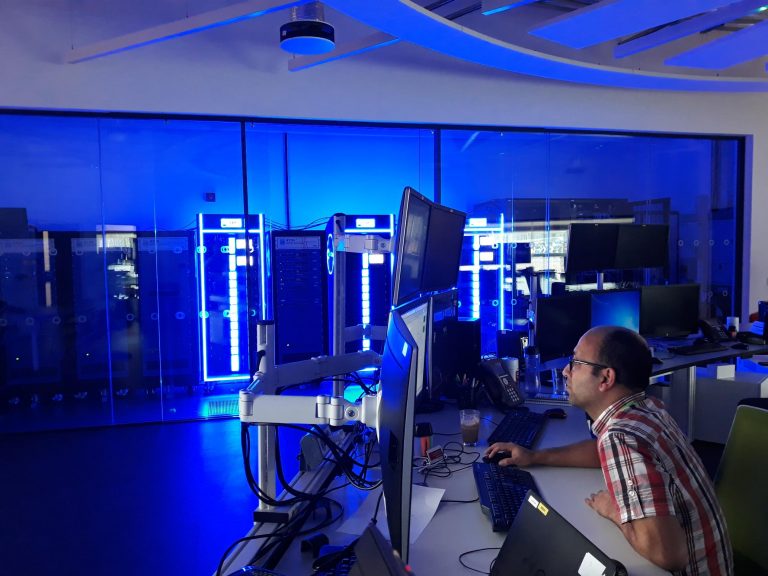
Traditional validation for an HVDC project’s control and project systems stopped at the factory acceptance tests performed by the vendor. Today, most projects go further by opting for an HVDC control replica – a reproduction of the control and protection cubicles that are installed in a laboratory, connected to an RTDS Simulator running the network model. Replicas are a major asset for HVDC project stakeholders, allowing for troubleshooting problems experienced in the network and controls, de-risking project modifications, and familiarizing operators with the new technology. The National HVDC Centre houses several control replicas for this purpose.
“We’re taking on the analysis of a project’s control and protection beyond the factory acceptance test and the functional system test within that,” says Marshall. “It’s important for us to mirror, with the same accuracy, the same perturbances that would be seen at the factory acceptance test, and then take that into a wider analysis environment, encompassing other devices and the system. And we do that using the same approach that the vendors use, which is RTDS.”
De-risking Europe’s first multi-terminal VSC-HVSC project
A key project for the Centre was the de-risking of the Caithness-Moray HVDC link in Shetland, Scotland. Hardware-in-the-loop testing of replica controls with the RTDS Simulator allowed the Centre to support the timely and on-budget completion of the project. With its original point-to-point link commissioned successfully in 2019, the project was designed for multi-terminal expansion to accommodate the connection of additional renewable power in the region.
“We were focused on de-risking the HVDC connection in Caithness-Moray in Shetland… recently it’s commissioned its third terminal and that makes it, in Europe, the first VSC-HVDC multi-terminal arrangement,” says Marshall. “Now we’re in that world of looking at multi-vendor networks going forward… we’ve been busy modelling those, and we model that in RTDS.”
Giving operators confidence in new technologies
Beyond studying power system dynamics and testing and validating new technologies, the RTDS Simulator provides the National HVDC Centre with a platform for training operators and giving confidence to stakeholders when it comes to the secure operation of planned projects.
“The transformational experience is when operators come to the Centre or we remotely stream a reference model to them,” Marshall commented. “They’re able to see in real time the sequences of control, the sequences of energization, the operational conditions, and the trade-offs involved in operating these DC networks for the first time. We often lose sight of the power of a flight simulator,” Marshall notes. “It helps… to manage systems that none of us have experience operating today.”
Scaling up: Toward a digital twin of the GB system
Looking ahead, the Centre is planning a major expansion—more than quadrupling its real-time simulation laboratory capacity, with plans to work toward a highly detailed wide area model of Great Britain’s power system. This ambitious initiative will enable deeper analysis, faster innovation, and more confident decision-making across the grid.
“We’re entering a brave new world and at the heart of that is confident simulation… the penny has finally dropped that real-time is a key part of de-risking,” says Marshall. “This is really just the beginning… we’re looking at more than quadrupling the footprint of the centre, building a real digital twin of the whole GB system. It’s an exciting environment – tons of growth – lots more to come.”
Learn more by watching the video here